ML and Agentic Research

We are exploring a wide variety of machine learning and agentic research projects relevant to our work in quantum sensing. AI agents are increasingly common in experimental science, but they can be challenging to use well. We study how agentic workflows fit within experimental physics and how they can be used most effectively for robust scientific work.

Our current activities include:

  • Developing and testing tools and benchmarks for agentic research in experimental physics, including our open-source framework PhysKit.
  • Promoting good practices for robust agentic science, with a focus on better documentation and easier verification of agent work
  • Accelerating our research with closed-loop agentic campaigns, including autonomous experiment control and adaptive measurement protocols.
  • Creating and refining neural networks for specialized performance in data analysis.

Machine Learning for Quantum Sensing

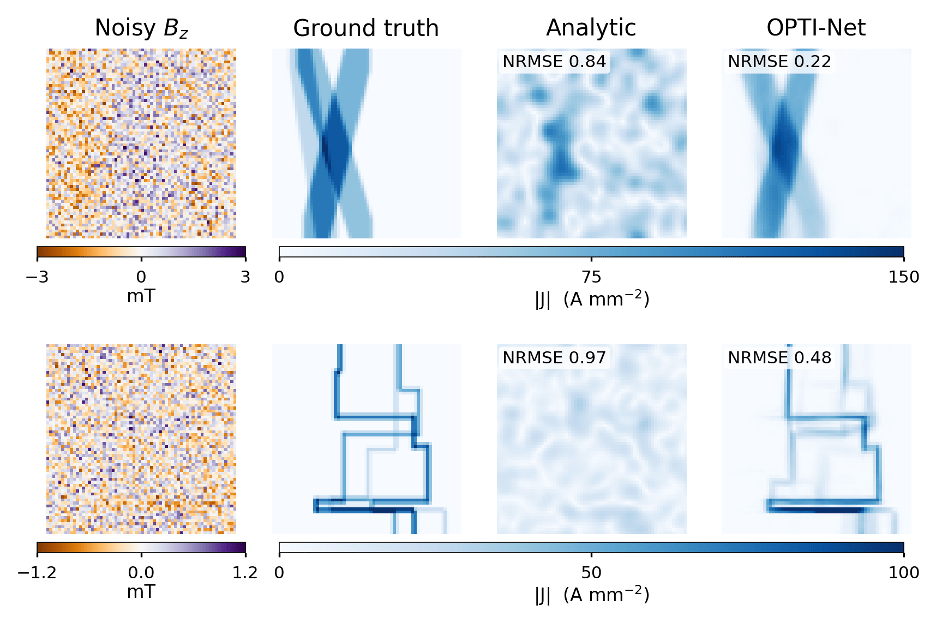
We have developed a range of neural network architectures to tackle data analysis problems in complex quantum sensing data. Examples include classifying integrated-circuit activity and detecting hardware trojans from QDM images, and reconstructing current densities from noisy magnetic images far better than standard analytic methods. We also use machine-learned interatomic potentials to speed up simulations of nuclear-recoil damage tracks in diamond for directional dark matter detection.

Current density reconstruction campaign. From left to right, columns depict: (i) Bz component of synthetic noisy vector magnetic field images used as inputs; (ii) ground truth current density from the synthetic test data; (iii) analytic current density reconstruction; and (iv) neural-network-enabled current reconstruction on the same data.

Agentic Research

In an agentic research campaign, an agent works independently toward a well-defined goal set by the researcher. We have run campaigns in device design, quantum control, neural network optimization, physical model identification and data analysis. Results include a neural network for current-density reconstruction with 33% lower error than our previous best on synthetic test data; a photodynamic model of the boron-vacancy spin defect in hBN that fits measured data better than published models; a fabrication-ready microwave waveguide design; and a pulse sequence that improves simulated performance more than tenfold.
Autonomous Hardware Control
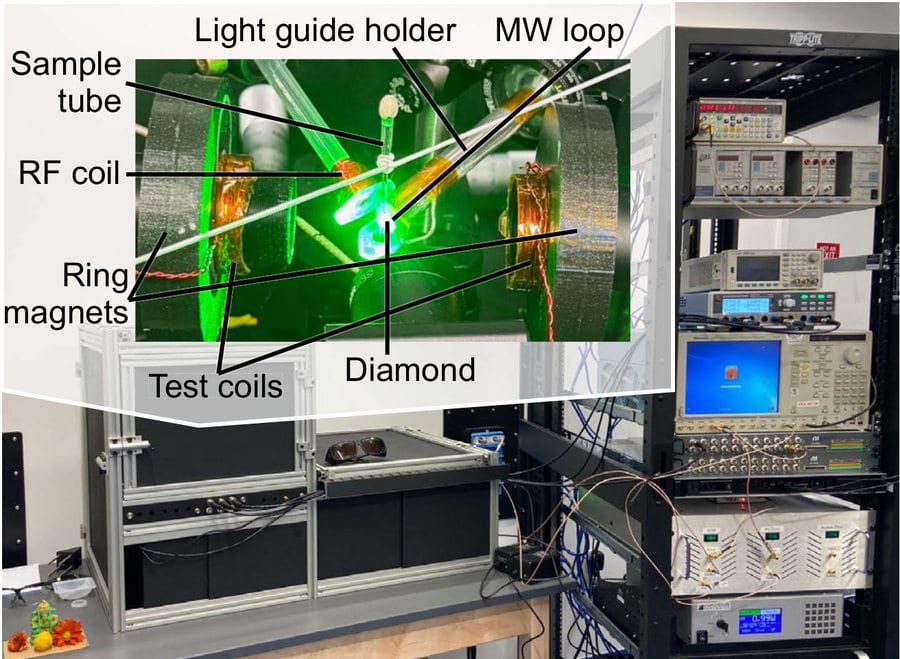
Agents can also operate laboratory hardware directly. Given control of an NV-NMR spectrometer, safety limits and a commissioning protocol with no parameter values, an agent took the uncalibrated setup to its first proton NMR signal in 61 minutes and to precision runs in 3.2 hours, reaching about 1 Hz frequency precision over 151 experiments in 20.8 hours. We are now extending this approach to autonomous experiment control and adaptive measurement protocols across our quantum sensing experiments.

The NV-NMR apparatus, with the sensor head shown in the inset.

Check out the PhysKit preprint for more case studies!

Publications

  • Principles and Techniques for Agentic Research in Experimental Physics. Niko R. Reed, Declan M. Daly, Andrew J. Beling, Jordan D. Giandrea, Ronald L. Walsworth, John W. Blanchard, and Daniel Ang. arXiv:2610.17193 (2026). PDF
    BibTeX
    arXiv
  • Directional Dark Matter Detection and Beyond: Diamond as a Platform for Mineral Detectors. Daniel Ang, Chinmay Bharathulwar, Priyanshu Bhattacharya, Mason Camp, Anson Cook, Gavishta H. M. Liyanage, Maximilian Shen, Jiashen Tang, and Ronald L. Walsworth. In Mineral Detection of Neutrinos and Dark Matter 2026 Proceedings, pp. 38–43 (2026). PDF
    BibTeX
    arXiv

  • Progress Toward a Solid-State Directional Dark Matter Detector. Daniel Ang, Jiashen Tang, Maximilian Shen, Mason Camp, Andrew Gilpin, Gavishta Liyanage, and Ronald L. Walsworth. In Mineral Detection of Neutrinos and Dark Matter 2025 Proceedings, pp. 18–21 (2025). PDF
    BibTeX
    arXiv
  • Machine learning for improved current-density reconstruction from two-dimensional vector magnetic images. Niko R. Reed, Danyal Bhutto, Matthew J. Turner, Declan M. Daly, Sean M. Oliver, Jiashen Tang, Kevin S. Olsson, Nicholas Langellier, Mark J.H. Ku, Matthew S. Rosen, and Ronald L. Walsworth. Phys. Rev. Appl. 23, 034035 (2025). link PDF
    BibTeX
    arXiv

  • Hardware Trojan Detection Using Unsupervised Deep Learning on Quantum Diamond Microscope Magnetic Field Images. Maitreyi Ashok, Matthew J. Turner, Ronald L. Walsworth, Edlyn V. Levine, and Anantha P. Chandrakasan. J. Emerg. Technol. Comput. Syst. 18 (2022). link PDF
    BibTeX
    arXiv

  • Magnetic Field Fingerprinting of Integrated-Circuit Activity with a Quantum Diamond Microscope. Matthew J. Turner, Nicholas Langellier, Rachel Bainbridge, Dan Walters, Srujan Meesala, Thomas M. Babinec, Pauli Kehayias, Amir Yacoby, Evelyn Hu, Marko Lončar, Ronald L. Walsworth, and Edlyn V. Levine. Physical Review Applied 14, 014097 (2020). link PDF supplement
    BibTeX
    arXiv