Fundamental Physics
The original core activity of the Walsworth Group is the development of precision measurement tools, such as atomic clocks, and the application of these tools to precision tests of fundamental physics. From 1990 to 2010, we developed noble gas and hydrogen masers and used them to perform some of the most sensitive tests to date of Lorentz symmetry for the neutron and proton.
Our current focus is on dark matter. We are pursuing a new approach to direct detection of weakly interacting massive particles (WIMPs) below the “neutrino floor” background. We will use quantum defects in diamond to identify the direction of incident WIMPs. When a WIMP scatters in the diamond crystal, the induced nuclear recoil will create a tell-tale damage cluster, localized to within about 100 nm, with an orientation to the damage trail that correlates well with the direction of the recoil and hence the incoming WIMP. This damage cluster induces strain in the crystal, which can be measured optically via the quantum defects.
We are also actively investigating avenues to characterize the Milky Way’s dark matter distribution through direct measurements of stellar accelerations and pulsar timing. Accelerations induced by the Milky Way’s gravitational potential leave spectroscopic imprints in the light from stars, an effect that can be observed using next-generation telescopes and comb-calibrated spectrographs. Additionally, these acceleration signatures may be found in timing data from millisecond pulsars, which are known to be some of the best known natural clocks in the universe. Acceleration measurements are key to advancing understanding of the local dark matter distribution because, unlike standard kinematic approaches, they do not assume dynamical equilibrium (a poor assumption for the Milky Way).
Directional Detection of WIMP Dark Matter
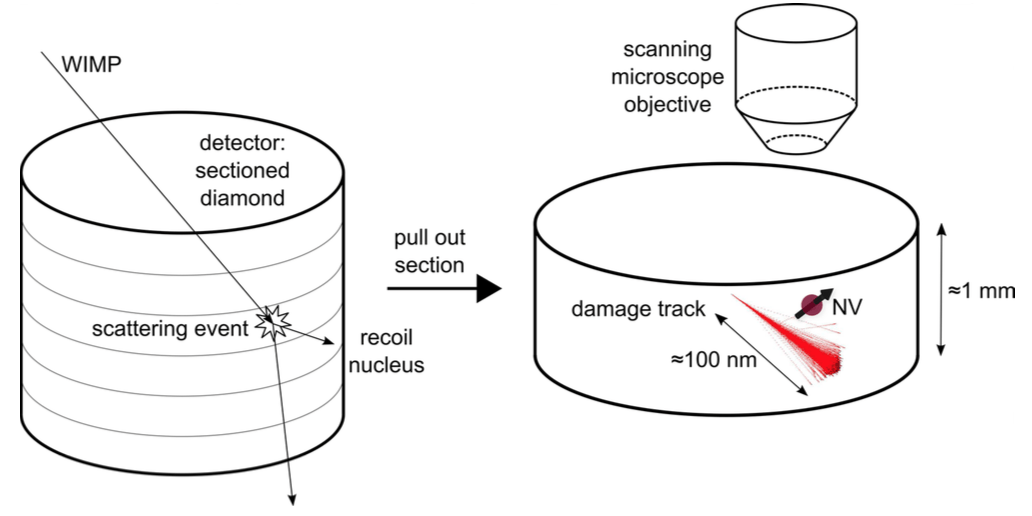
Our proposed approach to direction detection of WIMP dark matter is outlined in this cartoon. Left: WIMP (or neutrino) scattering event in large diamond volume is identified by conventional methods. Right: Damage track in target section is identified by optical strain mapping using NV or SiV centers distributed in the diamond at high density.
Publications
- Directional Dark Matter Detection and Beyond: Diamond as a Platform for Mineral Detectors. . In Mineral Detection of Neutrinos and Dark Matter 2026 Proceedings, pp. 38–43 (2026). PDF arXiv
BibTeX
- Multi-scale reconstruction of single-ion damage tracks in diamond via nitrogen-vacancy centers. . arXiv:2606.23621 (2026). PDF arXiv
BibTeX
- Measuring Pulsar Distances from Chirping Orbital Periods. . arXiv:2602.15110 (2026). PDF arXiv
BibTeX
 PDF
 link
- Progress towards a solid-state directional dark matter detector. . In Mineral Detection of Neutrinos and Dark Matter 2024 Proceedings, pp. 18–21 (2024). PDF arXiv
BibTeX
- GALILEO: Galactic Axion Laser Interferometer Leveraging Electro-Optics. . Phys. Rev. Lett. 132, 101001 (2024). link PDF supplement arXiv
BibTeX
- Directional detection of dark matter using solid-state quantum sensing. . AVS Quantum Science 4, 044701 (2022). link PDF arXiv
BibTeX
- Snowmass2021 Cosmic Frontier Dark Matter Direct Detection to the Neutrino Fog. . arXiv:2203.08084 (2022). link PDF arXiv
BibTeX
- High-Precision Mapping of Diamond Crystal Strain Using Quantum Interferometry. . Phys. Rev. Applied 17, 024041 (2022). link PDF arXiv
BibTeX
- Scanning X-Ray Diffraction Microscopy for Diamond Quantum Sensing. . Phys. Rev. Applied 16, 054032 (2021). link PDF supplement arXiv
BibTeX
- Ultraheavy dark matter search with electron microscopy of geological quartz. . Phys. Rev. D 104, 015041 (2021). link PDF arXiv
BibTeX
- Milky Way Accelerometry via Millisecond Pulsar Timing. . Phys. Rev. Lett. 126, 141103 (2021). link PDF supplement arXiv
BibTeX
- Directional detection of dark matter with diamond. . Quantum Science and Technology 6, 024011 (2021). link PDF arXiv
BibTeX
- Development of Quantum Interconnects (QuICs) for Next-Generation Information Technologies. . PRX Quantum 2, 017002 (2021). link PDF arXiv
BibTeX
- Probing Dark Matter Using Precision Measurements of Stellar Accelerations. . Physical Review Letters 123, 091101 (2019). link PDF supplement arXiv
BibTeX
- Gravitational wave detection with optical lattice atomic clocks. . Physical Review D 94, 124043 (2016). link PDF supplement arXiv
BibTeX