Astrophysics
Astrophysical spectroscopy is a powerful tool to study the properties of stars and other astrophysical objects. In particular, the presence of planets orbiting distant stars can be inferred from spectroscopic information because a planet’s gravitational tug on its host star imprints a periodic Doppler shift on the star’s spectrum. Detecting these stellar “wobbles” — known as radial velocity (RV) changes — is possible using modern high-resolution spectrographs. However, the detection of the very small Doppler shifts induced by small, rocky planets, like Earth and Venus (RV change <10 cm/s) requires wavelength calibration precision and stability beyond conventional wavelength standards. We have developed a laser frequency comb optimized for improved wavelength calibration — known as an “astro-comb” — that we are using to advance exoplanet science as well as cosmology & fundamental physics. Additionally, stellar physics, especially the effects of magnetically active regions on stellar surfaces, can induce apparent shifts in the spectrum corresponding to RV changes >1 m/s. To characterize and correct such shifts we have built a custom small telescope to study the one star whose velocity we know with certainty: the Sun.
Astro-Comb
Laser frequency comb technology addresses spectrograph wavelength calibration by providing a stable and ultra-precise optical ruler that can ultimately be referenced to an atomic clock. In addition to exoplanet research, frequency combs may also enable measurements of astrophysical dynamics relevant to cosmology. To this end, our group has pioneered the development of laser frequency combs for astrophysical applications, i.e. “astro-combs”. Our astro-comb architecture consists of a mode-locked Ti:sapphire laser, a photonic crystal fiber for nonlinear wavelength conversion into the middle of the visible spectrum, and a set of Fabry-Perot mode filters used for repetition rate multiplication. We have successfully deployed a green astro-comb at the Telescopio Nationale Galileo (TNG) in La Palma, Canary Islands as part of the HARPS-N project to search Earth-like exoplanets. As astro-combs gain traction as primary wavelength calibrators, we are working to improve their spectral coverage and automate their operation.
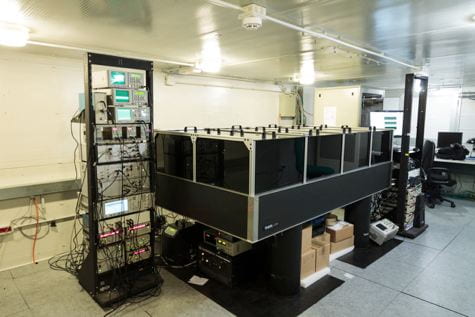
Photograph of the green astro-comb located at TNG telescope facility. The astro-comb system works reliably as a wavelength calibrator for HARPS-N with minimal tending over several months.
Solar Telescope
Despite the high-precision RV measurements possible with astro-combs, the activity of stars poses a major problem for detection of Earth-like exoplanets, as it adds large (~m/s) quasiperiodic fluctuations to the apparent RV changes, which cannot easily be discriminated from the effects of Earth-like exoplanets. To tackle this problem, we have deployed at the TNG an automated compact solar telescope that allows for disk-integrated spectroscopy of the Sun. This data is valuable to search for correlations between solar activity and spectroscopic parameters, with the goal of later applying this knowledge to Sun-like stars. We are currently developing statistical and machine learning tools to analyze this complex data set.
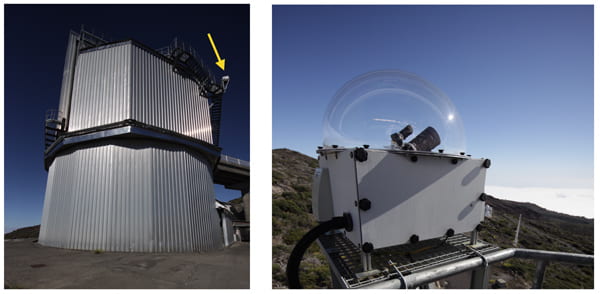
Left: Photograph of the TNG telescope, showing the location of our compact solar telescope. Right: Close-up of our solar telescope, taking “Sun-as-a-star” measurements.
Publications
 PDF
 link
- Estimating Magnetic Filling Factors from Simultaneous Spectroscopy and Photometry: Disentangling Spots, Plage, and Network. . The Astrophysical Journal 920, 21 (2021). link PDF arXiv
BibTeX
- Detection Limits of Low-mass, Long-period Exoplanets Using Gaussian Processes Applied to HARPS-N Solar Radial Velocities. . The Astronomical Journal 161, 287 (2021). link PDF arXiv
BibTeX
- Milky Way Accelerometry via Millisecond Pulsar Timing. . Phys. Rev. Lett. 126, 141103 (2021). link PDF supplement arXiv
BibTeX
- The spectral impact of magnetic activity on disc-integrated HARPS-N solar observations: exploring new activity indicators. . Monthly Notices of the Royal Astronomical Society 494, 4279–4290 (2020). link PDF arXiv
BibTeX
- Testing the Spectroscopic Extraction of Suppression of Convective Blueshift. . The Astrophysical Journal 888, 117 (2020). link PDF arXiv
BibTeX
- Sensitivity of low-degree solar p modes to active and ephemeral regions: frequency shifts back to the Maunder minimum. . Monthly Notices of the Royal Astronomical Society: Letters 489, L86–L90 (2019). link PDF arXiv
BibTeX
- Probing Dark Matter Using Precision Measurements of Stellar Accelerations. . Physical Review Letters 123, 091101 (2019). link PDF supplement arXiv
BibTeX
- Three years of Sun-as-a-star radial-velocity observations on the approach to solar minimum. . Monthly Notices of the Royal Astronomical Society 487, 1082–1100 (2019). link PDF arXiv
BibTeX
- HARPS-N Solar RVs Are Dominated by Large, Bright Magnetic Regions. . The Astrophysical Journal 874, 107 (2019). link PDF arXiv
BibTeX
- An astro-comb calibrated solar telescope to search for the radial velocity signature of Venus. . Proceedings of SPIE 9912, 99126Z (2016). link PDF
BibTeX
- State of the Field: Extreme Precision Radial Velocities. . Publications of the Astronomical Society of the Pacific 128, 066001 (2016). link PDF arXiv
BibTeX
- Optimization of filtering schemes for broadband astro-combs. . Optics Express 20, 24987–25013 (2012). link PDF
BibTeX
- Conjugate Fabry-Perot cavity pair for improved astro-comb accuracy. . Optics Letters 37, 3090–3092 (2012). link PDF
BibTeX
- Calibration of an astrophysical spectrograph below 1 m/s using a laser frequency comb. . Optics Express 20, 13711–13726 (2012). link PDF
BibTeX
- Broadband dispersion-free optical cavities based on zero group delay dispersion mirror sets. . Optics Express 18, 23204–23211 (2010). link PDF
BibTeX
- Visible wavelength astro-comb. . Optics Express 18, 19175–19184 (2010). link PDF
BibTeX
- In-situ determination of astro-comb calibrator lines to better than 10 cm/s. . Optics Express 18, 13239–13249 (2010). link PDF arXiv
BibTeX
- Toward a broadband astro-comb: effects of nonlinear spectral broadening in optical fibers. . Optics Express 18, 12736–12747 (2010). link PDF arXiv
BibTeX